Launching Tomorrow's Researchers
IPR's SURA program helps students turn classroom interests into research experience
Get all our news
Working with this project over the summer has kind of helped solidify the fact that I want to continue to work within this field of public policy in the future.”
Brandon Burks
IPR Summer Undergraduate Research Assistant
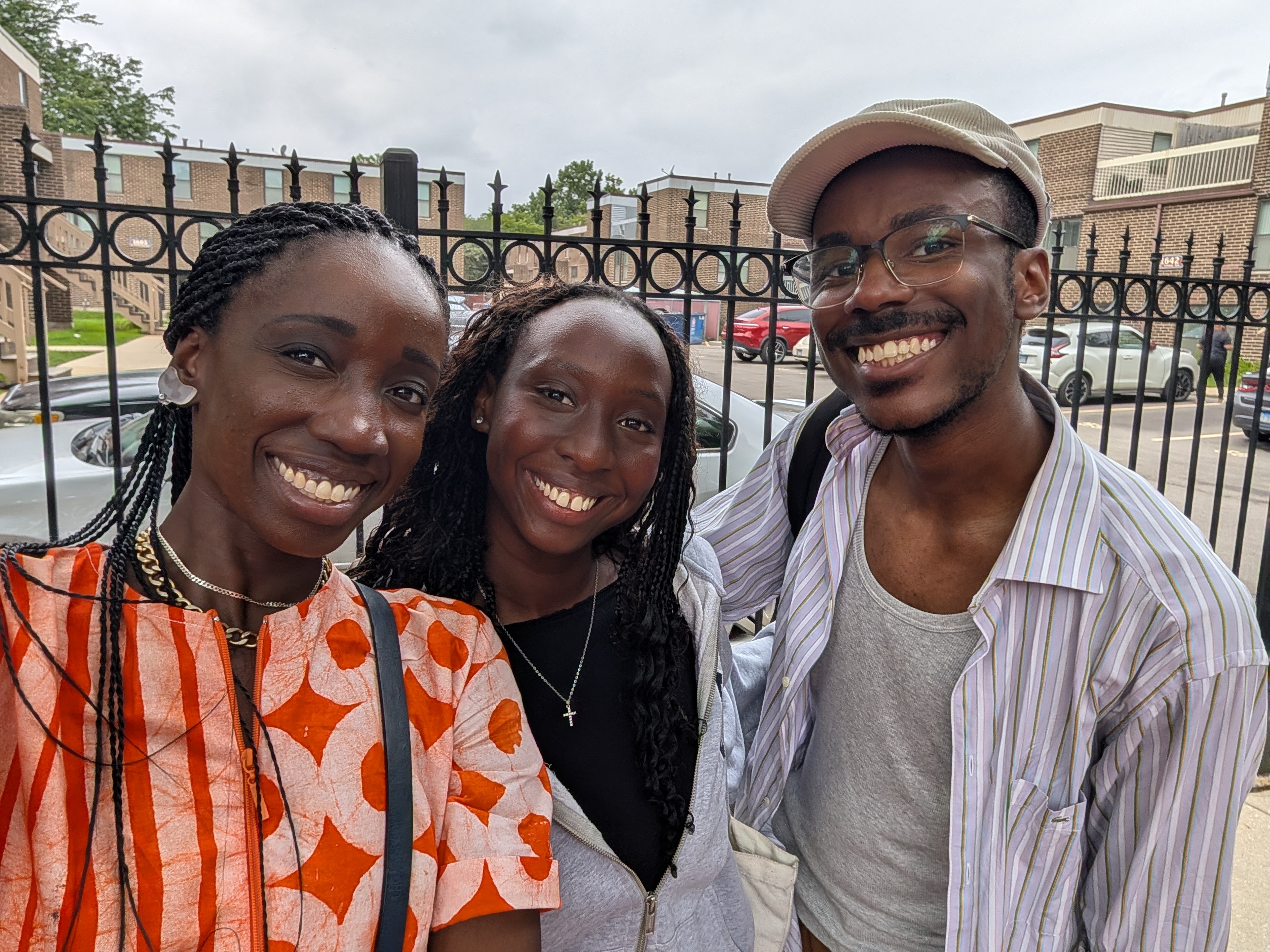
Sally Nuamah (from left) and her IPR research assistants, Mercy Nyamao and Brandon Burks, spent the summer documenting the history of a Chicago housing cooperative.
As a mechanical engineering major, Brandon Burks worked in a graduate policy class—and found the topics fascinating. That interest eventually led him to a class on race, inequality, and the political analysis of public policy, taught by IPR political scientist Sally Nuamah.
In the class, Burks, a junior, recalled being drawn to think critically about topics that didn't typically come across his desk. Seeing his enthusiasm, Nuamah suggested he apply for IPR's Summer Undergraduate Research Assistant (SURA) program. Burks said he was intrigued and applied.
"I wanted to do something over the summer instead of a 9-to-5 type of job," Burks said, adding that SURA gave him a way to dig deeper into research he'd already grown to care about.
The SURA program gives students the opportunity to engage in critical social policy research with professors. For almost three decades, undergraduates have joined faculty research through SURA, collecting data and learning methods directly from faculty. That investment strengthens the pipeline of people capable of driving meaningful, evidence-based change.
Burks worked alongside junior Mercy Nyamao on Nuamah's project. Nyamao said she appreciated the camaraderie of having another student to talk to about the project.
A political science major, Nyamao also found the SURA program after taking Nuamah's class and appreciated the opportunity to acquire research experience.
“I’m really interested in the intersection of race and law, specifically how Black and Brown people are affected by legal procedures and how they get legal advice and help,” Nyamao said.
The pair worked with Nuamah to archive and document a community’s history within a Chicago housing cooperative. They coded and scanned documents and conducted interviews, as well as visiting a history museum and research consortium.
“I feel like this summer she was really pushing us to do things that a researcher would do that maybe we wouldn't have done,” Nyamao said. “She was pushing us out of our comfort zones, but always letting us know the help is there.”
Nyamao said the experience also taught her something about her own strengths: She was drawn more to the community-facing parts of the work, like interviewing residents, than to data work behind a screen.
Nuamah said Burks and Nyamao came into the project with no research experience but quickly picked up new skills.
"They were truly extraordinary research assistants,” Nuamah said. “They learned about archiving, interviewing, and coding. They also got to visit the community and be a part of it. I couldn't have asked for a better group of students.”
Burks said the experience sharpened his grasp of the technical side of research while also broadening his view of the community they were documenting.
“Working with this project over the summer has kind of helped solidify the fact that I want to continue to work within this field of public policy in the future,” Burks said, appreciating how SURA acted as a catalyst for his varied experiences.
Investigating Threats Against Elected Officials
Sophomores Jeremy Mau and Lilly Kanter worked alongside IPR political scientist and associate director Laurel Harbridge-Yong to explore the causes and effects of threats of political violence against elected officials.
Mau and Kanter, like Burks and Nyamao, were drawn to the research opportunity because of classes they had taken. They began working with Harbridge-Yong during the spring quarter, then applied to continue the project through SURA. They helped recruit hard-to-reach populations for the study and clean data.
Mau, a double major in physics and political science, said their tasks changed as the project progressed. They started by sending out surveys, then shifted to data analysis, and, more recently, moved into redacting sensitive information.
Originally undeclared for his second major, Mau said the project helped narrow his options.
“Working with Professor Harbridge-Yong through SURA has been one of the biggest factors in me becoming more interested in political science,” Mau said. Along the way, he added, Harbridge-Yong also taught him new research tools, including Qualtrics and Box.
Kanter, a political science major, said Harbridge-Yong's organization and clear instructions helped her feel supported throughout the experience. She also said she learned from other elements of the project, including collaborating with professors from other institutions—UMass Lowell and the University of Illinois Chicago—and navigating the challenges of technology-based research.
“You have to have a good instinct for how to figure out issues, like when to push some things forward and push some things back,” Kanter said. She added that Harbridge-Yong taught her how research actually unfolds, including its pace and how projects can slow down unexpectedly.
Harbridge-Yong said the program exposes students to the research process while helping faculty advance their work, and it lets students get to know faculty personally.
“Through this process and our mentoring meetings, the students learned why different steps of the research process are important, how different aspects of the work connect, and how we stay attentive to research ethics and human subject protections,” Harbridge-Yong said.
Laurel Harbridge-Yong is professor of political science and IPR associate director. Sally Nuamah is associate professor of human development and social policy. Christine Percheski is associate professor of sociology and director of the Summer Undergraduate Research Assistants (SURA) Program. All are IPR fellows.
Published: September 28, 2026.