Seed Grants Carve Paths to Possible Future Funding
IPR faculty use small grants as scaffolding for bigger projects
Get all our news
Given the limited funds to cover small-scale pilots, this IPR support is really important. Demonstrating proof of concept through a pilot study will increase my chances for success in getting a larger grant.”
Julia Behrman
IPR sociologist
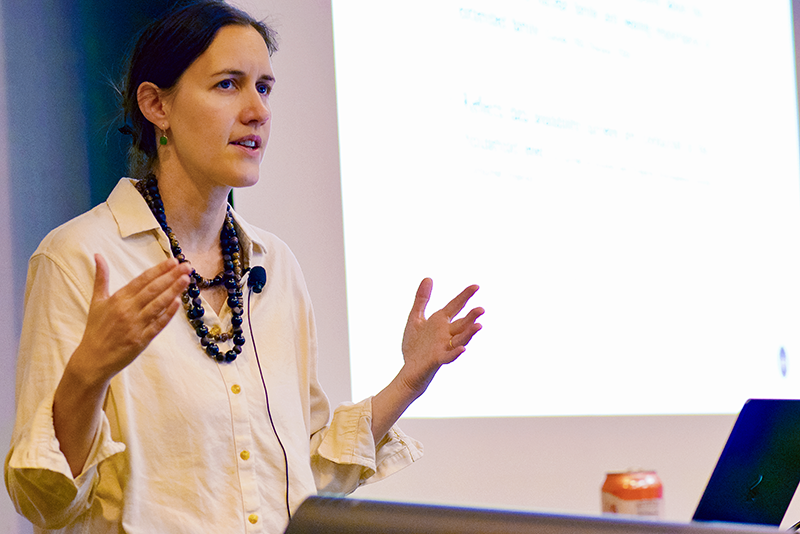
IPR sociologist Julia Behrman will use her seed grant to study declining fertility rates in the U.S
Earlier this year, IPR awarded six seed grants to seven faculty members and doctoral students from four disciplines. These modest awards—around a few thousand dollars each—are set to have a big impact in getting new research on timely topics off the ground.
“Given the limited funds to cover small-scale pilots, this IPR support is really important,” said IPR sociologist Julia Behrman. “Demonstrating proof of concept through a pilot study will increase my chances for success in getting a larger grant.”
Understanding Low Fertility in the U.S.
Behrman is using her funding to investigate the reasons why fertility rates are declining in the U.S. One prevailing theory points to rising economic inequality. Behrman’s past work, however, supports another—that the decline is more about changing societal norms than economic stability. To shed light on the debate, she will survey a sample of 1,850 American adults to understand the reasons behind their choices to have, or not have, children. This pilot study will help set the stage for a larger nationally representative survey.
Experiences of Prejudice Within Romantic Relationships
How might one partner’s prejudice affect the dynamic in an interracial romantic relationship? IPR social psychologist Michael Kraus and Northwestern doctoral student Kylie Davis are applying their award to identify how such relationships can provide social support yet also undermine one’s sense of identity and belonging when their partner is prejudiced. The researchers are recruiting cross-race romantic couples who have been together for at least a year to take part in a survey and interviews. The study will examine how often discrimination occurs among interracial couples, detailing how it might be related to political beliefs and relationship satisfaction.
Social Network Discrimination and Voting Rights
IPR legal scholar and economist Chika Okafor’s seed grant funding extends his previous research on “colorblind” policies, social network discrimination, and inequality into voting rights law. Okafor originated the concept of social network discrimination, which captures how minority groups receive fewer economic and social opportunities even under race-neutral rules due to group size, given people’s tendency to connect with others like themselves. This project shows that social network discrimination also shapes political opportunity, compounding across candidacy, fundraising, mobilization, and coalition-building. It highlights the Supreme Court’s incoherence in its landmark Louisiana v. Callais decision, which requires plaintiffs to separate race from politics even though race structurally shapes partisan patterns.
Understanding the Impact of Anti-DEI Litigation
IPR social psychologist Ivuoma Onyeador will use her seed grant to study the rise of conservative lawsuits against diversity, equity, and inclusion (DEI) programs. Her prior examination of organizations sued by conservative groups shows that 60% altered their programs as a result, with half of them removing all equity language from their programs. In this next phase, Onyeador will develop a richer dataset to understand if the themes of a conservative lawsuit predict organizational responses—as well as to inform future investigation of how employees evaluate their organizations’ responses to anti-DEI lawsuits.
Measuring Physician Altruism in Italy
IPR economists Molly Schnell and Silvia Vannutelli are putting their funds towards a pilot project in Italy that extends Schnell’s U.S. work on how physicians balance their patients’ needs against other considerations. The project uses incentivized online experiments to elicit measures of practicing physicians’ altruism, risk aversion, and other preferences. Schnell has applied these methods to U.S. physicians. Vannutelli brings institutional knowledge of Italy's health system, which will shape the Italian survey design and inform the interpretation of cross-country differences. Together, the results will speak to how institutional structures shape physician behavior and how incentive-based reforms might affect patient outcomes.
Outsourcing Government Capacity
Vannutelli received another seed grant to jumpstart creation of a dataset on the outsourcing of U.S. government expertise. The dataset will link federal and state procurement data on consulting contracts to public employment records and measures of government performance. She hopes to answer key questions such as: Why do agencies hire consultants instead of building in-house capacity? How does reliance on consultants affect employees’ job satisfaction? And what how does outsourcing core state functions reshape these agencies over the short and long term?
Photo credit: Lily Schaffer
Published: August 6, 2026.