IPR Scholars Reckon with Cuts and Uncertainty
At an IPR panel, three researchers reflected on a year of federal funding disruptions
Get all our news
I’m here to do research, and so as long as I can still do that, unless someone knocks on my door and takes away my laptop, we’re going to just keep plugging.”
Katie Insel
IPR neuroscientist
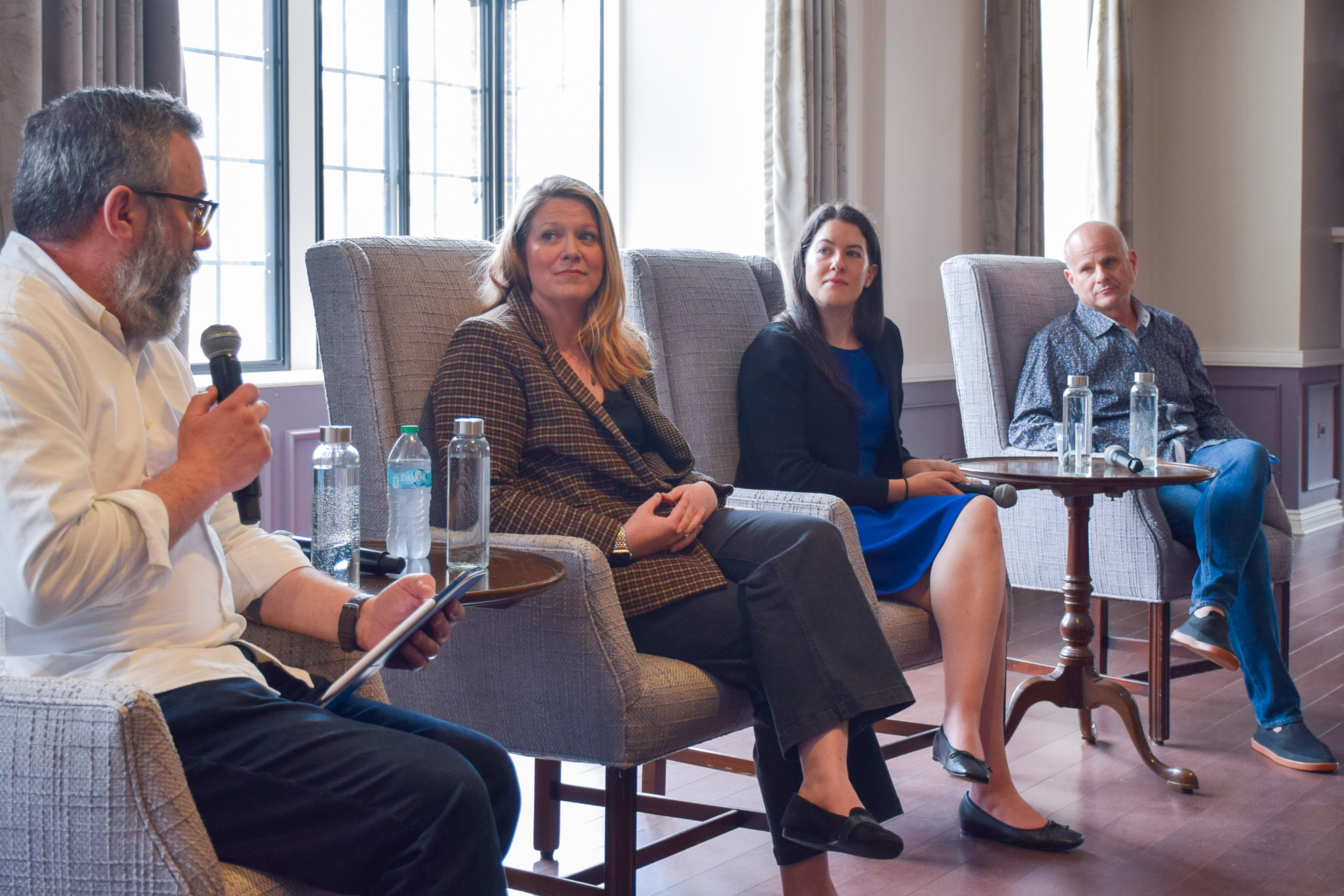
Andrew Papachristos (moderator), Elizabeth Tipton, Katie Insel, and Dean Karlan
(from left) discuss a year of federal funding disruptions at an April IPR panel.
Everyone told IPR neuroscientist Katie Insel that her first year as a faculty member would be hard—new students, new colleagues, a course load to balance against the pressure to publish.
She arrived at Northwestern in 2024 as an assistant professor of psychology with a National Institutes of Health (NIH) training grant to support her transition from postdoc to independent researcher.
In March 2025, a two-minute email exchange sent that grant into legal purgatory.
Insel’s grant was included in a batch flagged by the Department of Government Efficiency (DOGE) as being related to diversity, equity, and inclusion (DEI).
She shared her experience at an April 13 IPR panel discussion, joining IPR faculty Elizabeth Tipton, a statistician, and Dean Karlan, a development economist, in sorting through their experiences trying to keep their research, disciplines, and even an entire agency, afloat.
“Out of all the stress and chaos, I learned that our community is very, very strong,” Insel said. “I didn't know if anything was going to be okay, but I felt like there were people I could talk to, or who went through similar things.”
Insel’s story illustrates some of the complex issues researchers currently face in funding their research. She joined a legal challenge to the cancellations, securing a court-ordered reinstatement of her funding for the year.
Tipton, who served as president of the Society for Research and Educational Effectiveness in 2025, spent much of the past year fighting a similar battle in education research. DOGE entered the Department of Education in February 2025 and canceled $900 million in federal research contracts. The move gutted the Institute of Education Sciences (IES), reducing its research and statistics workforce to a skeletal staff.
“My LinkedIn became a graveyard,” Tipton said. “Every day, it would be people posting, ‘I lost my job, I was just laid off, what am I going to do?’”
IES is the federal hub for education research, housing four centers that collect data, evaluate programs, and fund research. It produces the Nation’s Report Card—the only nationally comparative measure of student academic performance.
Tipton is also concerned about losing education researchers to industry. Researchers with strong methodological skills began leaving education for tech and finance, while some left to start their own firms. Congress has since pushed back, maintaining IES funding and directing the department to rehire staff. But IES still employs only 31 people, down from more than 200 before the cuts.
“This is not something that can just be fixed by turning it back on,” Tipton said. “We’ve actually lost, potentially, a huge portion of the field.”
Karlan, who resigned as chief economist of the U.S. Agency for International Development (USAID) in February 2025, saw a similar pattern play out in foreign aid. The Trump administration dismantled the agency in early 2025, terminating more than 80% of its programs before officially shutting it down July 1.
He spent his time at the agency building the Office of the Chief Economist from scratch and shifting $1.7 billion in awards toward evidence-backed programs—work he described as just hitting its stride when it was shut down. There had been real momentum, he said—bipartisan enthusiasm for what the office was accomplishing—and then it was gone.
Still, he’s cautiously optimistic about the future of foreign aid. “Whether it’s three years or seven years,” he said, “there is a path.”
For all three panelists, their experiences reframed what it means to do research in the public interest, but none of them are retreating.
“I’m full professor, I have a job at an institution that is stable—I’m just going to lean into it,” Tipton said. “Stop feeling guilty about the fact that you’re not taking on a beautiful new research project at this moment. Working to advocate for the field is important.”
Insel said she realizes she has no control over the broader context. While the play-by-play of what she’s supposed to do as junior faculty has changed, her objective hasn’t.
“I’m here to do research, and so as long as I can still do that, unless someone knocks on my door and takes away my laptop, we’re going to just keep plugging.”
Katie Insel is an assistant professor of psychology and an IPR fellow. Dean Karlan is the Frederic Esser Nemmers Distinguished Professor of Economics and Finance and an IPR associate. Elizabeth Tipton is a professor of statistics and data science and an IPR fellow.
Photo credit: Patricia Reese
Published: June 29, 2026.