Rethinking Researchers’ Role in the Newsroom
Medill and IPR experts make the case for deeper collaboration between researchers and journalists
Get all our news
How do we regain the trust of the public? We are so balkanized now—we burrow into our echo chambers, and we are always looking for confirmation bias, and that's the media that we turn to. ”
Charles Whitaker
Medill Dean and IPR Associate
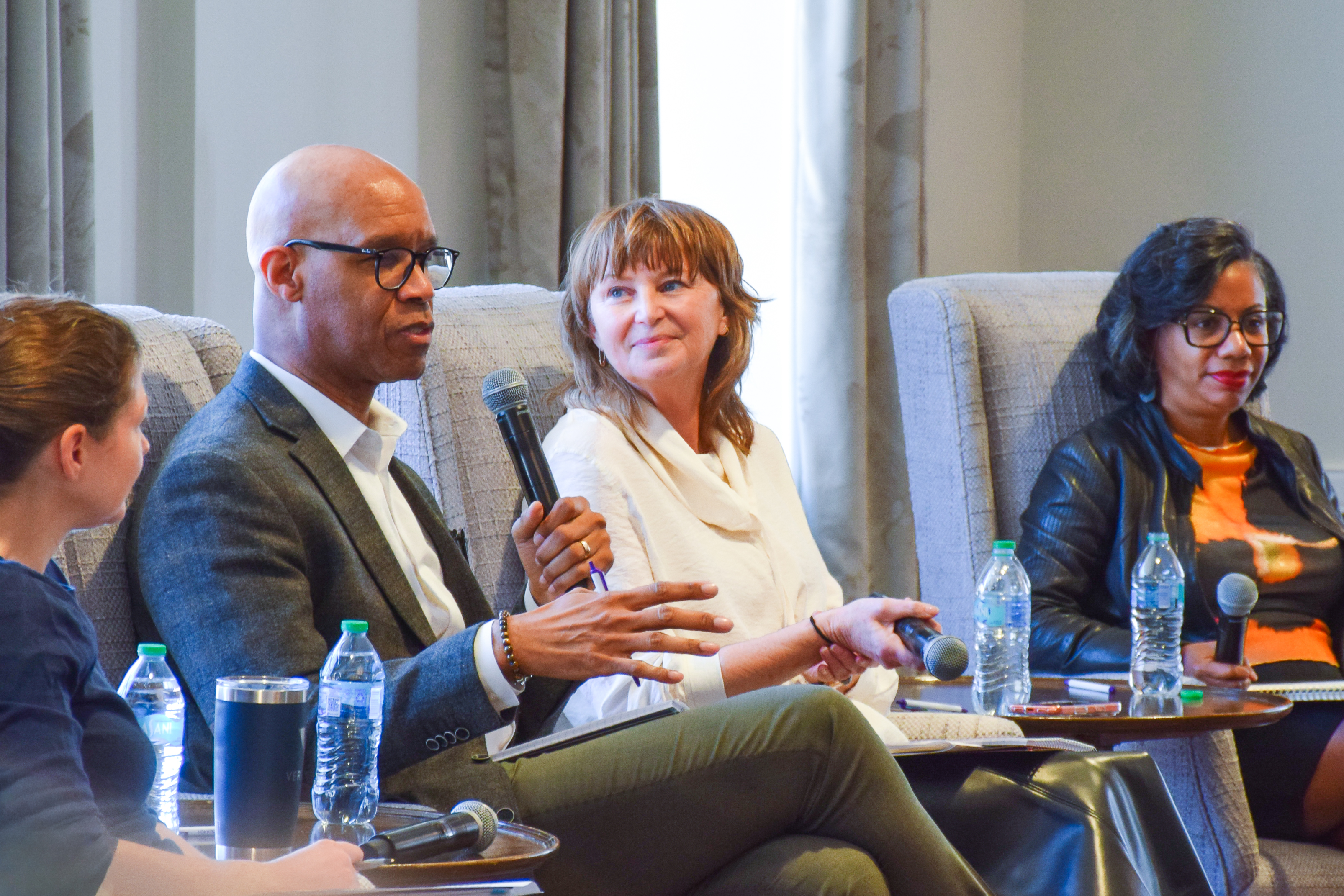
Charles Whitaker, Louise Kiernan, and Natalie Moore (from left) discuss how researchers
and journalists can work together during a Northwestern panel.
Journalism and science may seem worlds apart, but both share a steadfast commitment to accuracy. In an era of eroding trust in both fields, the challenge is how journalists and researchers can work together to produce reliable information the public not only sees, but believes.
“How do we regain the trust of the public?” said Charles Whitaker, dean and professor at the Medill School of Journalism, Media, and Integrated Marketing Communications. “We are so balkanized now—we burrow into our echo chambers, and we are always looking for confirmation bias, and that's the media that we turn to.”
Speaking to more than 65 faculty, students, and community members at an IPR and Medill panel on March 9, Whitaker, an IPR associate, was joined by Medill faculty and IPR associates Louise Kiernan and Natalie Moore to discuss how journalists and researchers can translate research into stories that shape policy and public understanding. IPR political scientist Laurel Harbridge-Yong moderated the discussion.
From Source to Partner
Kiernan explained that scholars typically play one of five different roles when working with journalists: background expert, source, character, partner, or journalist. Of those roles, she said the most interesting is partner.
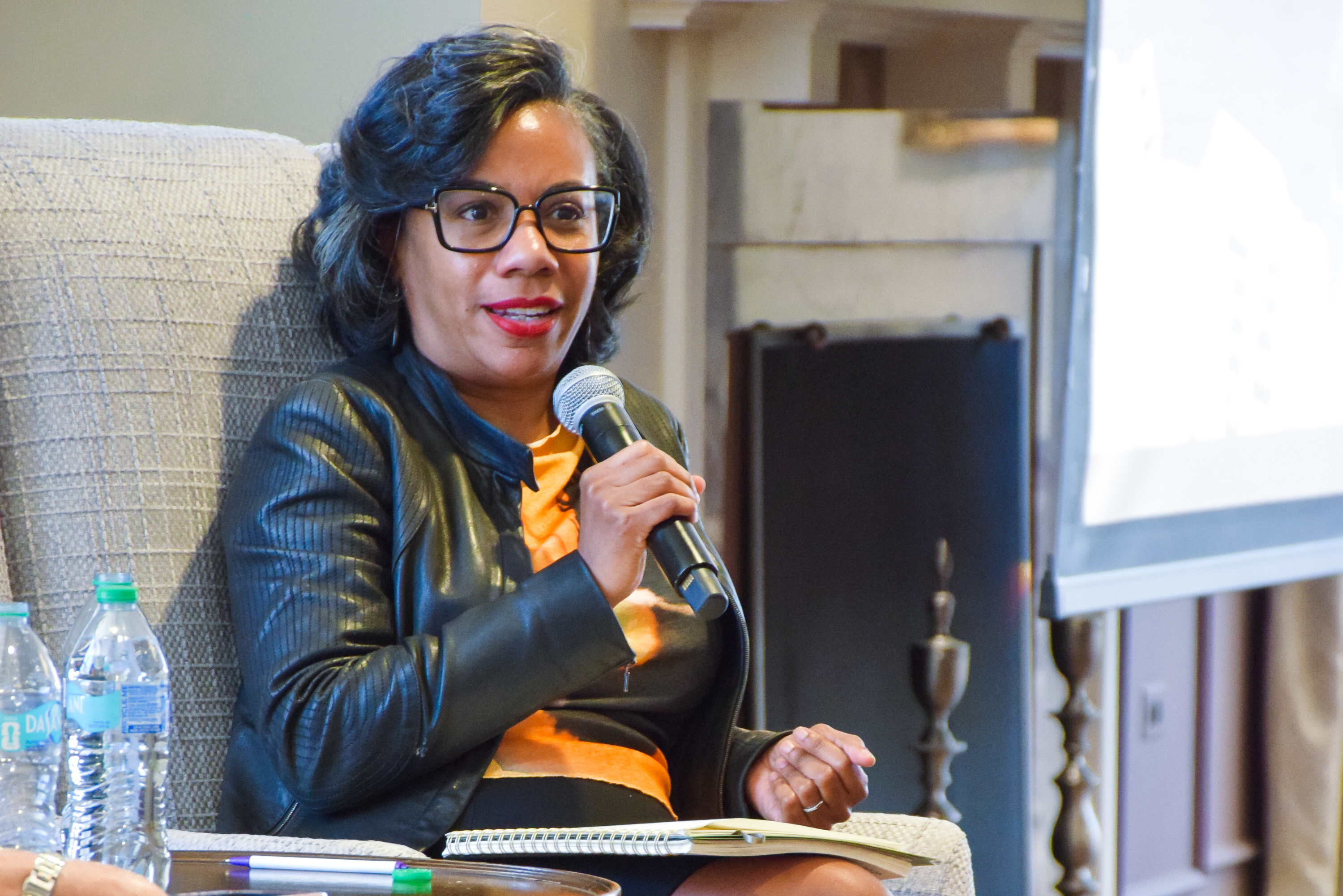
Natalie Moore discusses how data and lived experiences
combine to tell stronger stories.
Moore offered her own example of a partnership between scholars and the media from her work at WBEZ, which stemmed from her frustration with a buzzword commonly heard when discussing Chicago neighborhoods.
“The hill that I will die on is that ‘gentrification’ is the most overused word, and it does not happen in most Chicago neighborhoods,” she said.
Her team at WBEZ partnered with the University of Illinois at Chicago's Natalie P. Voorhees Center for Neighborhood and Community Improvement to tell the story of Chicago's changing neighborhoods. The center developed a Gentrification Index, which examined neighborhood change across Chicago from 1970 to 2010, and measured how much a neighborhood's wealth or poverty changed during this time.
Moore said the partnership gave them the data to tell the “real story,” which was that Chicago’s middle class was shrinking.
“Partnering with UIC gave us the weight that this wasn't just anecdotal,” she said. The data allowed the story to go beyond quoting people, but those anecdotes still served as “added value—the lived experiences—to match the data.”
Know Your Role
Whitaker said knowing your role in the story is the first place to start and pointed back to Kiernan’s framework of the five roles researchers can play.
“Why is this journalist reaching out to you? Often, it's for commentary, clarity, analysis, and sometimes, rebuttal,” Whitaker said. “Then think through, ‘What do I want to contribute to this article?’ And understand that anything you say could be a soundbite.”
Kiernan also addressed a common source of confusion: what “off the record” actually means. She said she asks her investigative reporting students the question as a trick—because the answer is that it means whatever your source thinks it means. Before speaking with a journalist, she advised, make sure you're both working from the same understanding of the ground rules.
Beyond the mechanics of an interview, Kiernan pointed to a common complaint from scholars: Journalists oversimplify research. She explained that there is an “inherent tension between nuance, which is the realm of the scholar, and clarity, which is the realm of the journalist.” Journalists, however, can feel that researchers are overly cautious, and she noted that both sides should keep in mind that journalism and academia are very different cultures.
The panelists also offered advice for fostering relationships with journalists. Moore encouraged scholars to take the first step and put their work on the radar of journalists, even if they’re not asking for immediate coverage for a specific study.
“Introduce yourself and start sending your studies or articles,” Moore said. “You’re not necessarily asking for coverage, but you're disseminating your work.”
Kiernan advised thinking of interactions with journalists less as transactions and more as a relationship.
“If you identify someone who's interested in what you're interested in, drop them an email and ask if they want to meet for coffee,” Kiernan said. “It is as simple as that to build a relationship with them.”
Become an Influencer (Yes, Really)
The panelists agreed that partnership with journalists is valuable, but is it enough? Moore encouraged scholars to write more op-eds and noted that while the New York Times is a high bar, local outlets like the Chicago Sun-Times are more within reach. The key, she said, is a news hook—connecting your work to something happening right now.
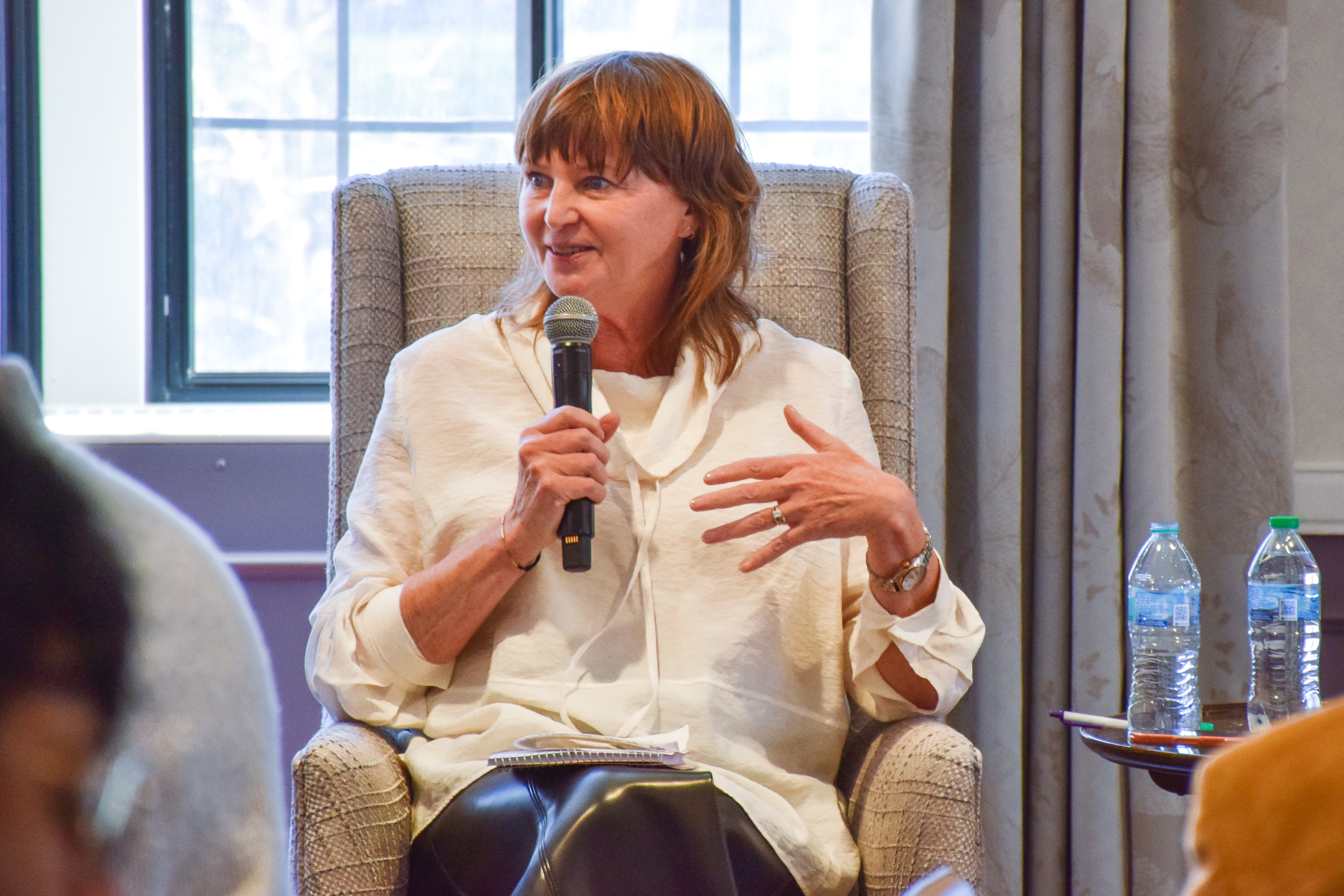
Louise Kiernan advises researchers to cultivate relationships
with journalists.
Kiernan added that most journalists start by conducting a Google search, so the more you have out in the world, the easier you are to find. Journalists also use social media heavily, she noted, and academics who have built a presence on platforms like Bluesky find it a valuable route to getting attention.
But the panelists pushed further. Whitaker made the case that scholars should consider becoming influencers in their own right—taking to YouTube, for example, to communicate their work directly to the public.
Moore said she’s “cranky” when it comes to discussions of influencers. She acknowledged that there are ways to do it well, although it’s worth thinking about how you want to spend your time in a crowded field.
“It's a lot to consider as we are weighing this next phase of media consumption that we're already in—and AI coming for us,” Moore said.
Whitaker acknowledged that influencers are increasingly the primary source of information for many people, particularly young people, so they’re a “force to be reckoned with.” The beauty of the modern age, he said, is that anyone can post to the internet—which also makes it a terror.
It might be a perfect time, he continued, for scholars to create a presence with factual information that is “getting across news and information that would help people not just understand their work but understand what's happening in our world.”
Kiernan agreed that more scholars are needed in this space. “Like journalists, they have a commitment to accuracy,” she said.
Louise Kiernan is professor and director of strategic initiatives at Medill. Natalie Moore is senior lecturer and director of audio journalism programming at Medill. Charles Whitaker is dean and professor at Medill. Laurel Harbridge-Yong is professor of political science and IPR associate director. All are IPR faculty.
Photo credits: Lily Schaffer
Published: April 21, 2026.