DNA Project Seeks to Reunite Ukrainian Children with Their Families
More than 35,000 have vanished into Russia since the start of the war
Get all our news
It’s not super clear when those children will be returned, if ever. And that’s why it’s important now to develop a system to help collect family DNA. ”
Tabitha Bonilla
IPR political scientist
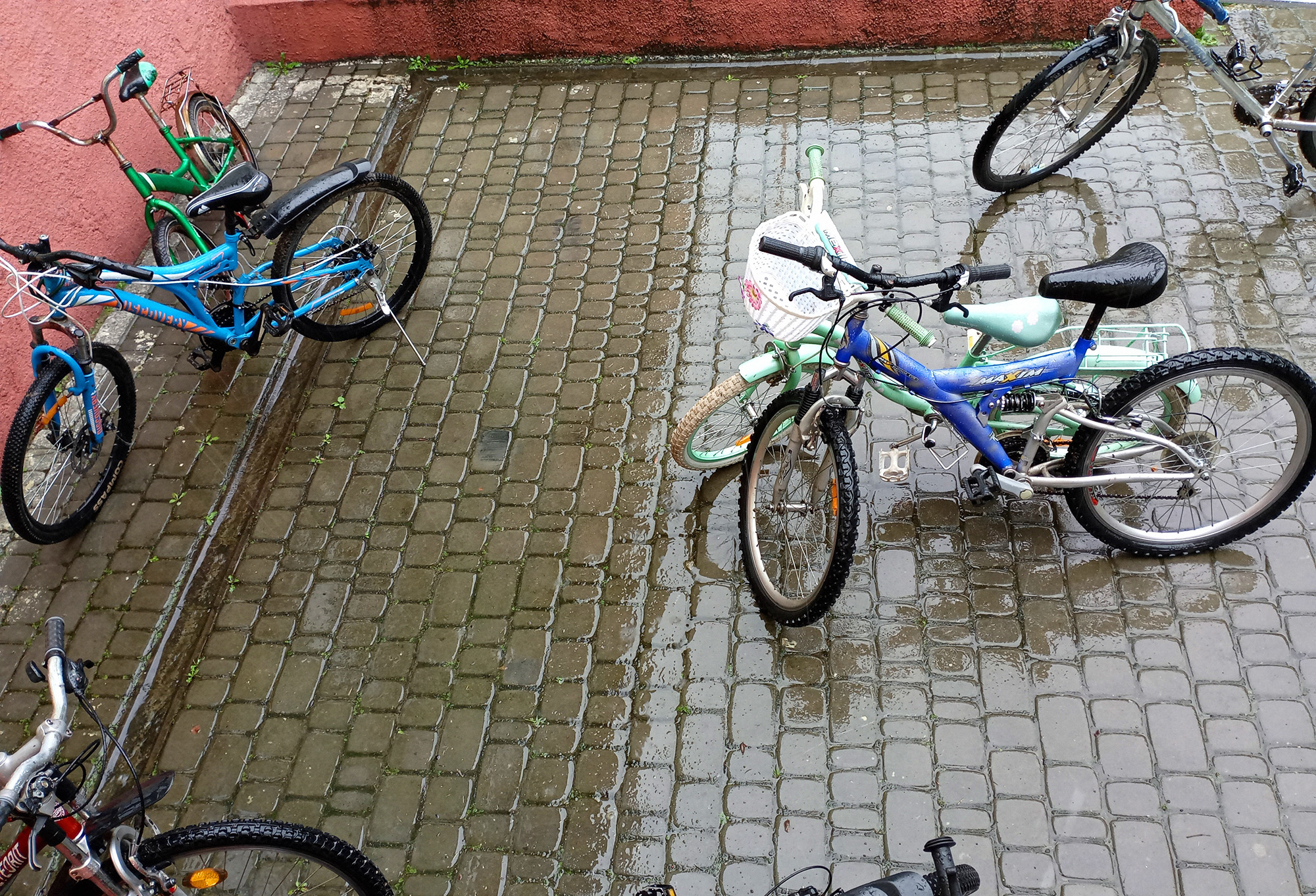
Bicycles parked on wet cobblestones in Kornalovichi, Ukraine.
As the four-year-long Russia-Ukraine War drags on, an estimated 1.8 million Russians and Ukrainians have been killed, wounded, or are missing. While many point to this grim statistic on the war’s fourth anniversary, less is known about an equally grim one: the more than 35,000 Ukrainian children who have vanished into Russia and Russian-controlled territories.
“It’s not super clear when those children will be returned, if ever,” IPR political scientist Tabitha Bonilla said. “And that’s why it’s important now to develop a system to help collect family DNA.”
Over the summer, Bonilla and three team members traveled more than 5,000 miles from Chicago to Warsaw and ultimately Kyiv as part of the Global FamDNA Working Group. This group, housed at Northwestern, is working to establish a DNA repository to allow Ukrainian families—and others torn apart by conflicts, disasters, or even immigration policies—to reunite with their missing children now and decades down the line.
Bonilla co-leads the working group with Feinberg geneticist and IPR associate Sara Huston, an expert in genetic testing applications. It represents the first effort to build a global DNA repository to help missing adults and children reunify with their families.
“The global missing persons infrastructure is pretty weak,” Huston said.
The repository would pave the way for a more humanitarian-focused method of collecting DNA from families to allow missing people to be reunited with their families quickly once found. The researchers seek to protect the data so that governments, for example, could not use them in harmful ways. They are also sorting out complex issues around ethics, legal barriers, and logistics.
Forced Family Separations in the U.S. Launched the Project
Bonilla first started working on the project with Huston in 2019, merging her expertise on human trafficking policy and Huston’s expertise in child reunification and DNA identification. The project revved up in 2022 when Russian forces started abducting thousands of Ukrainian children, with reports of the children being subject to forced “Russification” and illegal adoptions.
The group hopes that Ukraine can serve as a test case to help with family reunification all over the world. Over the past two years, the project has become even more critical as immigration enforcement has tightened and forced family separations have increased in the U.S. and elsewhere.
As an expert in political communication and messaging, Bonilla is helping to address an issue that Huston and the team had previously uncovered: How waning trust in government affects communication with families around an eventual reunification process. She works with a multidisciplinary team of psychologists and behavioral researchers, as well as DNA, trauma, and legal experts, most of whom are based at Lurie Children’s Hospital of Chicago.
Laying the Groundwork
While in Ukraine, the research team interviewed around 30 internally displaced families, including relatives of some affected families with missing children. They wanted to find out how Ukrainians talk about the issue and how missing people are tracked and recovered.
“Who do they go to when they have a missing family member?” Bonilla said. “What do they know about how the children are disappearing?”
The researchers also developed a culturally grounded approach by forging local partnerships with universities and other nonprofits who document and record information on missing persons. They met with several organizations, like Save the Children and the International Commission on Missing Persons, Ukrainian academics at three universities, and a handful of government officials. In the final hours before they left, they even had a chance to speak with Ukraine’s Commissioner for Persons Missing in Special Circumstances, Artur Dobroserdov.
The interviews led to valuable insights regarding the pressing, and sometimes thorny, sociocultural, political, administrative, and privacy concerns that Ukrainians hold around the issue.
For instance, the research team spoke with a representative of the country’s Ministry of Health who pointed out that they kept receiving DNA machines to identify missing soldiers. Instead, what they needed were more swabs, cartridges, and other supplies.
“There was a lot of overlap,” Bonilla recalled. “We learned about what’s needed to identify missing soldiers, which is not quite our focus, and how some of those systems could be used, or are being used, to try and help locate and identify the missing children.”
Beyond the Pilot
Bonilla, Huston, and the team are now working to code and analyze the data and continue their conversations with the NGOs and government agencies to plan next steps. Bonilla expects that once they are finished, they will have some “clear guidance about how families are thinking about this problem.”
Their analysis should also shed light on the types of communication and education that families might need and what those who are conducting DNA work require in terms of on-the-ground support.
The project has received seed funding from Northwestern’s Buffett Institute for Global Affairs, but more funding and work is needed to fully launch it. Still, the motivation for the researchers—and Ukrainians—to get it fully running is strong.
“A lot of people wanted to talk to us because they want people to know what's happening,” Bonilla said. “They want their story honored and told.”
Tabitha Bonilla is an associate professor of human development and social policy, an IPR fellow, and co-leader of the Global FamDNA Working Group, with Sara Huston, a research assistant professor of pediatrics and an IPR associate.
Photo credit: iStock
Published: February 26, 2026.