Eli Finkel

Professor of Psychology | Professor of Management and Organizations

PhD, Social and Quantitative Psychology, University of North Carolina at Chapel Hill, 2001

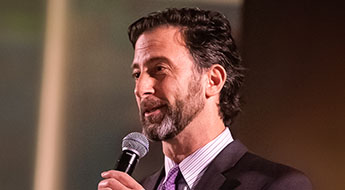
Eli Finkel—author of the bestselling book The All-Or-Nothing Marriage: How the Best Marriages Work (2017)—is a professor at Northwestern University, where he has appointments in the psychology department and the Kellogg School of Management. He also serves as the Morton O. Schapiro Fellow at the Institute for Policy Research and founding co-director of the Litowitz Center for Enlightened Disagreement. He studies romantic relationships and American politics. In his role as director of Northwestern’s Relationships and Motivation Lab (RAMLAB), he has published 170+ scientific papers and is a guest essayist for The New York Times. The Economist declared him “one of the leading lights in the realm of relationship psychology.” His new podcast, Love Factually, examines what romantic films get right and wrong about relationships. 

In addition to his research on relationship science, Finkel studies political psychology, with special focus on political sectarianism and antidemocratic tendencies in the U.S. He examines the intersection of interpersonal relationships and political speech and action. In addition to The All-Or-Nothing Marriage, he is the co-editor of four books. His research has received funding from the National Science Foundation, the John Templeton Foundation, and the National Institute on Aging, among others.

Current Research

The Social Media Discourse of Engaged Partisans. Political discourse on social media is infamously uncivil. Prevailing explanations argue that such incivility is driven by differences in ideological or social-identity conflict—partisans are uncivil because the political stakes are so high. Finkel and his colleague Michalis Mamakos consider a different (albeit not contradictory) possibility—that online political discourse tends to be uncivil because the people who opt into such discourse are generally uncivil. They are analyzing commenting behavior of over 6.3 million Reddit users across thousands of diverse cultural contexts (subreddits). They suggest an alternative hypothesis: People who opt into political discourse tend to be especially toxic, even when discussing non-political topics in non-partisan contexts. Such individuals disproportionately dominate political discourse online, thereby undermining the public sphere as a venue for inclusive debate.

Social-Emotional Polarization and Antidemocratic Tendencies. Does social-emotional polarization foster antidemocratic tendencies? Over the past decade, claims of such an effect have pervaded both popular commentary and scholarly discourse—to the point where the link has become widely accepted as an article of faith. But recent research has raised credible doubts. Even as Finkel and his colleagues replicate the effects underlying those doubts, they demonstrate that social-emotional polarization, when properly conceptualized and operationalized, does indeed predict antidemocratic tendencies. Leveraging cross-sectional, longitudinal, and experimental methods, including a study conducted during the U.S. 2022 midterm elections, they are developing and validating a measure of political sectarianism.

Selected Publications

Books

Finkel, E., and R. Baumeister, eds. 2019. Advanced Social Psychology: The State of the Science, 2nd ed. New York: Oxford University Press.

Finkel, E. 2017. The All-Or-Nothing Marriage: How the Best Marriages Work. New York: Dutton.

Journal Articles

vanDellen, M., Julian Wright, E. Finkel, G. Fitzsimons, and A. Hall. 2025. Interdependence in shared goal pursuit among established and impromptu dyads: Expectations, allocation, and performanceFrontiers in Social Psychology 3. 

Mamakos, M., T. Charlesworth, and E. Finkel. 2025. Moralizing partisanship when surrounded by co-partisans versus in mixed companyPNAS Nexus 4(4). 

Eastwick, P., E. Finkel, E. Meza, and K. Ammerman. 2025. No gender differences in attraction to young partners: A atudy of 4500 blind datesProceedings of the National Academy of Sciences 122(5). 

Lamarche, V., F. Kung, E. Finkel, E. Jayawickreme, A. Rattan, and T. Wheatley. 2024. How to give great research talks to any audienceNature Human Behaviour 8(4): 616–21. 

Hughes, E., L. Emery, E. McGorray, W. Gardner, and E. Finkel. 2024. TThe delusion of the disappearing self? Attachment avoidance and the experience of externally invisible self-loss in romantic relationshipsJournal of Personality and Social Psychology 128(5). 

McGorray, E., E. Finkel, and B. Feinstein. 2023. Bi+ identity visibility and well-being in the context of romantic relationshipsPsychology of Sexual Orientation and Gender Diversity 11(4): 631–40. 

Olson, J., S. Rick, D. Small, and E. Finkel. 2023. Common cents: Bank account structure and couples’ relationship dynamicsJournal of Consumer Research 50(4): 704–21.   

Slotter, E., P. Markey, A. Audigier, S. Dashineau, E. Finkel, and L. Luchies. 2023. Love’s a dance you learn as you Go: Evidence for interpersonal complementarity during romantic conflict and its association with relationship outcomesEuropean Journal of Social Psychology 53(4). 

Eastwick, P., E. Finkel, and S. Joel. 2023. Mate evaluation theoryPsychological Review 130(1): 211–41. 

Eastwick, P., S. Joel, K. Carswell, D. Molden, E. Finkel, and S. Blozis. 2022. Predicting romantic interest during early relationship development: A preregistered investigation using machine learningEuropean Journal of Personality 37(3): 089020702210858.  

McGorray, E., L. Emery, A. Garr-Schultz, and E. Finkel. 2023. ‘Mostly White, heterosexual couples’: Examining demographic diversity and reporting practices in relationship science research samplesJournal of Personality and Social Psychology 125(2). 

Baxter, A., J. Maxwell, K. Bales, E. Finkel, E. Impett, and P. Eastwick. 2022. Initial impressions of compatibility and mate value predict later dating and romantic interestProceedings of the National Academy of Sciences 119(45). 

Hartman, R., W. Blakey, J. Womick, C. Bail, E. Finkel, H. Han, J. Sarrouf, et al. 2022. Interventions to reduce partisan animosityNature Human Behaviour 6(9): 1194–205. 

Kteily, N., and E. Finkel. 2022. Leadership in a politically charged ageHarvard Business Review 3–11. 

Emery, L. and E. Finkel. 2022. Connect or protect? Social class and self-protection in romantic relationshipsJournal of Personality and Social Psychology 122(4): 683–99. 

Editorials

Finkel, E. J.  2024, June 23. The failings of the Chicago Principles when it comes to free speech. Chicago Tribune.