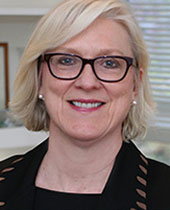
P. Lindsay Chase-Lansdale
Professor Emerita of Human Development and Social Policy
PhD, Developmental Psychology, University of Michigan, 1981
P. Lindsay Chase-Lansdale is the Frances Willard Professor Emerita of Human Development and Social Policy in the School of Education and Social Policy (SESP) and Vice Provost for Academics Emerita, Northwestern University.
She is the first developmental psychologist to be tenured in a U.S. public policy school (the Harris School, University of Chicago), and she was a Congressional Science Fellow of the American Association for the Advancement of Science (AAAS)/Society for Research in Child Development (SRCD), serving as a scientific legislative assistant in the office of then-Congressman Paul Simon.
She specializes in multidisciplinary research on societal issues and how they affect families and the development of children, youth, and parents. Much of her work has resulted in empirical evidence underlying programs and public policies that lead to positive social and educational outcomes. Specific topics include two-generation education interventions for parents and children, early childhood education, community college programs, workforce training, mothers’ employment, as well as family and child wellbeing.
Her success in the Office of the Provost (2013-20) was evident in the following results: more effective communication and collaboration between faculty and Northwestern’s leaders; the establishment of leadership programs for faculty as well as the Provost’s Advisory Council of Women Faculty; innovative faculty programs on how to communicate novel research findings to the media; strengthening the Searle Center for Advancing Teaching and Learning as well as the Center on Civic Engagement; guidance for the Office of Student Enrichment Services; and individual mentoring for faculty, chairs, associate provosts, and vice presidents.
In 2020, the provost established the P. Lindsay Chase-Lansdale Undergraduate Summer Research Grant in Social Policy for Children and Families, awarded annually to a student in honor of Chase-Lansdale’s service to the University, including her passion for and success in mentoring and advising students, faculty, and leaders.
Chase-Lansdale is an elected member of the National Academy of Education and a fellow in the American Psychological Association and the Association for Psychological Science. She is the recipient of the Society for Research on Adolescence (SRA) Social Policy Award as well as the Society for Research in Child Development (SRCD) Award for Distinguished Contributions to Public Policy for Children.
She was an elected member of the Harvard University Board, also serving as vice chair. For 25 years, she served on the board of the Foundation for Child Development, a national child policy and research philanthropy, and she chaired the board from 2002-11. She is a member of inaugural cohort (2012) of the Aspen Institute’s Ascend Leadership Fellowship, designed to bring innovative leaders together to promote a two-generation approach in policy, practice, and research. She also served on the National Advisory Committee of the Robert Wood Johnson Foundation Health & Society Scholars Program and chaired the Visiting Committee of the Harvard Graduate School of Education.
Chase-Lansdale received her BA from Harvard University and Radcliffe College, magna cum laude, in 1974 and her PhD in developmental psychology from the University of Michigan in 1981. She completed the Advanced Management Program at Northwestern University’s Kellogg School of Management in 2016.
Current Research
Chase-Lansdale is currently collaborating with IPR developmental psychologist Terri Sabol, and Dana McCoy, associate professor, Harvard Graduate School of Education, to develop new measures of domains of young child development, including curiosity, self-regulation, and perspective-taking. In addition, Chase-Lansdale and Sabol are planning a study of what hinders PreKindergarten access in several neighborhoods in Chicago.
Two-Generation Human Capital Interventions. In 2008, Chase Lansdale launched a research project on CareerAdvance®, a model, two-generation education intervention, developed and run by the antipoverty agency CAP Tulsa (Community Action Project of Tulsa County, Okla.). CareerAdvance® combines education and workforce training for young, low-income parents, with high-quality, early childhood education programs for children. The original research project has evolved into three longitudinal studies that continue into present day.
Together with IPR research professor Teresa Eckrich Sommer and Sabol, Chase-Lansdale evaluated the influence of CareerAdvance® on the psychological health, educational attainment, and economic well-being of families and children. CareerAdvance® provides not only educational programs for both parents and children, but also a number of key supportive components—career coaches, financial incentives, and peer group meetings—to prepare parents for careers in the healthcare sector.
Chase-Lansdale collaborated with Jeanne Brooks-Gunn of Columbia University, Christopher King of the University of Texas at Austin, Amanda Morris of Oklahoma State University, Hiro Yoshikawa of New York University, and CAP Tulsa to continuously expand and study this model two-generation intervention.
Funding for Chase-Lansdale’s research has come from the Administration for Children and Families, U.S. Department of Health and Human Services; Ascend at the Aspen Institute, Bill and Melinda Gates Foundation; Foundation for Child Development; Robert Wood Johnson Foundation, and W.K. Kellogg Foundation.
Selected Publications
Books
Smuts, A.B., R.W. Smuts, R.M. Smuts, B.B. Smuts, and P.L. Chase-Lansdale. 2006. Science in the Service of Children: 1893–1935. New Haven: Yale University Press.
Chase-Lansdale, P. L., K. Kiernan, and R. Friedman. 2004. Human Development Across Lives and Generations: The Potential for Change. New York: Cambridge University Press.
Duncan, G., and P.L. Chase-Lansdale. 2001. For Better and for Worse: Welfare Reform and the Well-Being of Children and Families. New York: Russell Sage Foundation.
Chase-Lansdale, P.L., and J. Brooks-Gunn, eds. 1995. Escape from Poverty: What Makes a Difference for Children? New York: Cambridge University Press.
Journal Articles
Chor, E., P.L. Chase-Lansdale, T.E. Sommer, T. Sabol, L. Tighe, J. Brooks-Gunn, et al. 2024. Three-year outcomes for low-income parents of young children in a two-generation education program. Journal of Research on Educational Effectiveness 17(4): 936–77.
Sommer, T.E., L. Tighe, T. Sabol, E. Chor, P.L. Chase-Lansdale, H. Yoshikawa, et al. 2024. The effects of a two-generation English as a Second Language (ESL) intervention on immigrant parents and children in Head Start. Applied Developmental Science 28(3): 227–46.
Sabol, T., T.E. Sommer, P.L. Chase-Lansdale, and J. Brooks-Gunn. 2021. Intergenerational economic mobility for low-income parents and their children: A dual development science framework. Annual Review of Psychology 72: 265–92.
Sommer, T.E., W. Schneider, E. Chor, T. Sabol, P.L. Chase-Lansdale, J. Brooks-Gunn, et al. 2020. A two-generation education intervention and children’s attendance in Head Start. Child Development 91(6): 1916–33.
Chase-Lansdale, P.L., T. Sabol, T.E. Sommer, E. Chor, A. Cooperman, J. Brooks-Gunn, et al. 2019. Effects of a two-generation human capital program on low-income parents’ education, employment and psychological well-being. The Journal of Family Psychology 33(4): 433–43.
Sommer, T.E., T. Sabol, E. Chor, W. Schneider, P.L. Chase-Lansdale, J. Brooks-Gunn, et al. 2018. A two-generation human capital approach to antipoverty policy. The Russell Sage Foundation Journal of the Social Sciences 4(3): 118–43.
Chase-Lansdale, P.L., R. Moffitt, B. Lohman, A. Cherlin, R. Coley, L. Pittman, et al. 2003. Mothers’ transitions from welfare to work and the well-being of preschoolers and adolescents. Science 299(5612): 1548–52.