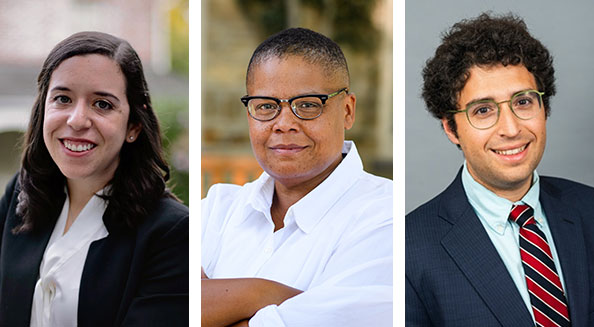
Elisa Jácome
Assistant Professor of Economics
PhD, Economics, Princeton University, 2021
Elisa Jácome’s research primarily focuses on topics in labor economics, public economics, and economic history. She is interested in questions related to criminal justice, immigration, mental health, and intergenerational mobility.
Jácome spent 2021–22 as a postdoctoral fellow at the Stanford Institute for Economic Policy Research (SIEPR) after receiving her PhD in economics from Princeton.
Her 2021 study “Intergenerational Mobility of Immigrants in the U.S. over Two Centuries” and 2024 study “Law-Abiding Immigrants: The Incarceration Gap Between Immigrants and the US-born, 1870–2020” received widespread media attention, including from the New York Times, Washington Post, CNN, and Bloomberg.
Current Research
Mental Health. Jácome is exploring the impact of mental health on economic outcomes. In one project, she and her co-authors are using Swedish administrative data to study the labor market consequences of mental health crises. The authors examine severe manifestations of depression, anxiety, and self-harm that culminate in a hospitalization, and show that these acute events generate substantial and lasting disruption in both earnings and employment.
Intergenerational Mobility. Jácome is studying the intergenerational mobility of immigrants in the United States, finding that immigrants have higher rates of upward mobility than children of the US-born. Ongoing work studies the reasons underlying immigrants’ higher upward mobility. Differences in childhood geography, parental education, and family structure account for little of the immigrant mobility advantage. Instead, children of non-Latin American immigrants have higher educational attainment, which accounts for most of their earnings advantage. Children of Latin American immigrants work more hours and have more years of labor market experience, which account for most of theirs.
Domestic Violence. Jácome's current research examines policy responses to gender-based violence in Chicago. She is co-principal investigator on an evaluation of the Targeted Abuser Call (TAC) program at Chicago's domestic violence courthouse, run by the Cook County State's Attorney's Office, which pairs vertical prosecution with wraparound services for survivors. She is also leading an evaluation of a cash transfer program for survivors of gender-based violence, which studies how direct financial assistance affects survivors' safety and economic well-being.
Selected Publications
Gonçalves, F., E. Jácome, and Emily Weisburst. 2026. Community engagement and public safety: Evidence from crime enforcement targeting immigrants. American Economic Review 116, no. 8: 3076-3109.
Jácome, E., I. Kuziemko, and S. Naidu. 2025. Mobility for all: Representative intergenerational mobility estimates over the 20th century. Journal of Political Economy 133(1): 1–384.
Abramitzky, R., L. Boustan, E. Jácome, S. Pérez, J. David Torres. 2024. Law-abiding immigrants: The incarceration gap between immigrants and the US-born, 1870–2020. American Economic Review: Insights 6(4): 453–71.
Jácome, E. 2022. The effect of immigration enforcement on crime reporting: Evidence from Dallas. Journal of Urban Economics 128: 103395.
Abramitzky, R., L. Boustan, E. Jácome, and S. Pérez. 2021. Intergenerational mobility of immigrants in the U.S. over two centuries. American Economic Review 111(2): 580–608.