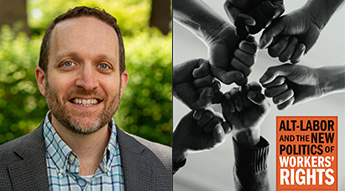
Daniel Galvin
Professor of Political Science
IPR Fellow (On leave, Fall 2026) and Chair of IPR’s Program on Policy Discourse and Decision Making | Director of the Workplace Justice Lab @ Northwestern
PhD, Political Science, Yale University
Daniel J. Galvin is a Professor of Political Science, a Faculty Fellow at the Institute for Policy Research at Northwestern University, and Director of the Workplace Justice Lab @ NU.
His current research focuses on labor policy and politics, worker organizations, and the enforcement of labor standards. His latest book, Alt-Labor and the New Politics of Workers’ Rights (New York: Russell Sage Foundation, 2024) examines the changing nature of workers’ rights over the last half-century and the political development of “alt-labor” groups (nonunion, nonprofit worker organizations), which are supporting and organizing predominantly low-wage immigrant workers and workers of color in their fight for their rights in the political and economic arenas. He also researches and writes on presidential politics, political parties, and American political development. Galvin is the author of Presidential Party Building: Dwight D. Eisenhower to George W. Bush (Princeton University Press), co-editor of Rethinking Political Institutions: The Art of the State (NYU Press), and has published numerous journal articles and book chapters.
His work has been recognized with several awards, including the Emerging Scholar Award from the American Political Science Association (APSA) section on Political Organizations and Parties, the Mary Parker Follett best article prize from the APSA Politics and History section (for “From Labor Law to Employment Law: the Changing Politics of Workers’ Rights”), and the Best Paper Award from the APSA Public Policy section (for “Deterring Wage Theft: Alt-Labor, State Politics, and the Policy Determinants of Minimum Wage Noncompliance”). His research has been supported by the Russell Sage Foundation, the Washington Center for Equitable Growth, the Economic Policy Institute, the National Science Foundation, the AT&T Research Fellowship, the Miller Center for Public Affairs, the LBJ Foundation, and the Dwight D. Eisenhower Foundation. His teaching has been recognized by the E. LeRoy Hall Award for Excellence in Teaching and the R. Barry Farrell Teaching Award, and he was twice elected by the Northwestern student body to the Faculty Honor Roll.
Galvin is currently chair of the Policy Discourse and Decision Making program and affiliated with the Race, Poverty, and Inequality program at the Institute of Policy Research. He is also affiliated with the Comparative-Historical Social Science (CHSS) program and the Center for the Study of Diversity and Democracy (CSDD) at Northwestern.
Current Research
Workplace Justice Lab@Northwestern University. The WJL@NU conducts research on workers’ rights and economic inequality and collaborates with local, state, and federal government agencies as well as worker centers, unions, and legal nonprofits. WJL@NU is part of a multi-institutional partnership that is anchored by the Workplace Justice Lab @ Rutgers University and includes the Pilipino Workers Center of Southern California. WJL runs two programs: (1) Beyond the Bill, which addresses the challenge of labor standards enforcement at all levels of government and (2) Build the Base, Grow the Movement, which supports learning and experimentation around a distributed organizing model for worker justice organizations and unions to expand their membership bases and grow their leadership teams.
Powers and Practices in Labor Standards Enforcement. Wage theft remains a pervasive problem internationally and within the United States. In response, worker advocates have sought stronger laws to deter violations and promote compliance. Yet formal authority alone may be insufficient; labor departments often fail to use the full extent of their legal authority to conduct vigorous enforcement. This raises two empirical questions: to what extent do agencies deploy available enforcement tools, and with what consequences? Drawing on a novel survey of U.S. state labor departments, new measures of statutory strength in wage-hour laws, and state-level estimates of minimum wage violations, Galvin and coauthors find widespread nonuse of available powers. This misalignment of powers and practices has substantive consequences: the predicted probability of minimum wage violation falls sharply as strategic enforcement practices increase, conditional on strong labor laws. However, this effect shows no measurable impact for some of the most vulnerable workers, suggesting limits in reaching those at greatest risk. The authors conclude by outlining a forward-looking research agenda on the (mis)alignment of powers and practices.
On “Deliverism.” "Deliverism"—the theory that voters reward parties for policies that tangibly improve their lives—has become the subject of significant public debate. This project critically examines the theoretical foundations of, and empirical evidence for, deliverism and its scholarly cousin, electoral theories of policy feedback. Galvin and coauthors argue that both theories rest on flawed assumptions about voter cognition and behavior; a review of existing empirical studies finds that even the most rigorous analyses identify only limited and highly conditional electoral effects. The authors suggest three constructive scholarly responses: first, investigate why deliverism theory continues to guide policymakers despite weak evidence of its effectiveness; second, focus more on scope conditions; third, examine alternative routes to achieving deliverism’s objectives, including party building and community-based organizing.
Selected Publications
Books
Galvin, D. 2024. Alt-Labor and the New Politics of Workers’ Rights. New York: Russell Sage Foundation.
Galvin, D. 2010. Presidential Party Building: Dwight D. Eisenhower to George W. Bush. Princeton, N.J.: Princeton University Press.
Galvin, D., with Ian Shapiro and Stephen Skowronek, eds. 2006. Rethinking Political Institutions: The Art of the State. New York: NYU Press.
Articles and Book Chapters
Galvin, D., D. Woodly, R. Block Jr., H. Han. 2026. Democratic Organizing and Political Change: Toward a Research Agenda. The Forum: A Journal of Applied Research in Contemporary Politics.
Galvin, D., H. Shepherd, J. Round, J. Barnes, J. Fine. 2026. Powers and Practices in Labor Standards Enforcement. Regulation & Governance.
Galvin, D. 2025. “What’s APD Got to Do with It?” in Causal Inference and American Political Development: New Frontiers, Jeffery Jenkins, ed. (Springer-Verlag New York).
Galvin, D. and J. Seawright. 2023. Surprising Causes: Propensity-Adjusted Treatment Scores for Multimethod Case Selection. Sociological Methods & Research 52(4): 004912412110046.
Galvin, D. and C. Thurston. 2022. APD as a problem-driven enterprise. Studies in American Political Development 36(2):156–8.
Fine, J., D. Galvin, J. Round, and H. Shepherd. 2021. Wage theft in a recession: Unemployment, labor violations, and enforcement strategies for difficult times. International Journal of Comparative Labour Law & Industrial Relations 37(2): 107–32.
Galvin, D. 2020. Labor’s legacy: The construction of subnational work regulation. ILR Review 74(5): 1103–31.
Galvin. D. and J. Hacker. 2020. The political effects of policy drift: Policy stalemate and American political development. Studies in American Political Development 34(2): 216–38.
Galvin, D. 2020. Party domination and base mobilization: Donald Trump and Republican Party building in a polarized era. The Forum: A Journal of Applied Research in Contemporary Politics 18(2): 135–68.
Galvin, D. 2019. From labor law to employment law: The changing politics of workers’ rights. Studies in American Political Development 33(1): 50–86.
Popular Writings
Galvin, D. 2024. “Building Power at the Margins of the Labor Market: Understanding why and how low-paid workers are mobilizing through the alt-labor movement,” Symposium on Labor and Workers in the American Political Economy, June 5. 2024.
Galvin, D. “How Workers Without Unions are Fighting for Justice,” Power at Work, April 14.