Visiting Scholar Tracks How the Social Becomes Biological
UT Austin sociologist Bridget Goosby examines the health toll of living in an unequal society
Get all our news
It’s not just that we have complex systems that we exist in, but that those complex systems that we exist in are interacting with the complexities of our bodies.”
Bridget Goosby
UT Austin sociologist and IPR visiting scholar
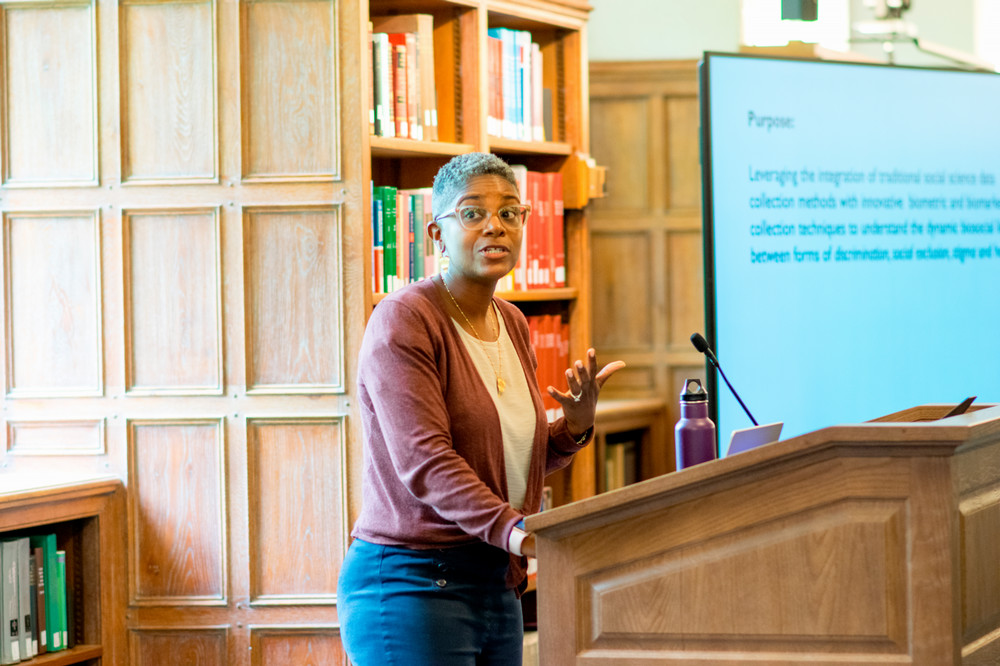
During an IPR colloquium, Bridget Goosby describes the innovative methods
she and her team are using to understand how discrimination affects health.
Sociologist and demographer Bridget Goosby opened her May 18 IPR colloquium the same way she opens all of her talks, by confirming what “race” is—and isn’t.
“[Race] is a social construction, it is not biological, and these categories are used to distinguish groups of people and maintain inequality and oppression,” she said.
That distinction is the foundation of her research. Race has no biological basis—but the experience of living as a racialized person in an unequal society leaves measurable marks on the body.
As a professor of sociology at the University of Texas at Austin and co-director of the LifeHD Health Disparities Research Lab, she is among the nation’s leading voices on how racism becomes physically embedded in the body over a lifetime.
Goosby’s work investigates exactly how that happens: the biosocial pathways through which social marginalization and resulting chronic stress translate into higher disease risk, faster biological aging, and shorter lives.
Her visit was the latest in IPR’s Visiting Scholars Program, which brings distinguished researchers to campus to share findings, collaborate with faculty, and engage students on pressing social policy questions.
‘My Second Intellectual Home’
Goosby’s connection to IPR dates back to her participation in the 2008 and 2011 sessions of the Cells to Society Biomarker Institute, a summer program that brought together researchers interested in linking social conditions to biological processes. Led by IPR faculty, the institute convened researchers who believed that understanding inequality meant looking not just at people’s circumstances, but at what those circumstances were doing to their bodies. It was one of the first training institutes in the nation to trace these connections by teaching researchers how to use biomarkers––measurable signs in blood, saliva, sweat, or tissues that reveal what is happening inside the body.
Calling IPR her “second intellectual home,” Goosby has continued to collaborate with IPR biological anthropologist Thomas McDade and IPR health psychologist Greg Miller.
“She’s really putting the ‘bio’ in ‘biosocial’ in serious and interesting and innovative ways,” McDade said.
“One of the things that I most admire about Bridget’s work,” he continued, “is that she’s doing the hard work to advance theory in this space, while also designing new data collection efforts that apply innovative collection technologies and analytic tools.”
When Racism Gets Under the Skin
The health disparities Goosby studies are stark. Research shows that Black Americans, American Indians, and Alaska Natives face significantly lower average life expectancies than White, Hispanic, or Asian populations.
Scientists have found that racial discrimination is associated with increased blood pressure, inflammation, and allostatic load—cumulative biological wear from chronic stress. This in turn means a higher likelihood of conditions such as diabetes and heart disease.
In one line of research, racial discrimination accounted for more than half of the total race-related difference in pro-inflammatory gene expression, a biological pathway linked to a wide range of chronic diseases.
“It’s not just that we have complex systems that we exist in, but that those complex systems that we exist in are interacting with the complexities of our bodies,” Goosby said.
Goosby’s research probes these processes—not to locate the causes of health disparities within individuals, but to trace them back to the social environments and policies that produce them.
Measuring Stress in the Moment
To capture biosocial interactions, Goosby and her collaborators have pushed well beyond traditional research methods. Most large longitudinal datasets measure social experiences in year-long intervals, which miss the moment-to-moment biological responses that her theory predicts.
Her innovation, developed with UT collaborator Jacob Cheadle, involves highly intensive studies charting new methodological territory in unpredictable day-to-day environments—not the controlled space of the lab.
In practice, this means mapping wearable device data, collected at six-second intervals, onto daily diary entries reconstructed in 15-minute windows. This allows researchers to pinpoint exactly when a moment of experiencing discrimination triggers a response in the body.
Designing these studies from scratch paid off: “We got strong signals in that work,” Goosby said.
A study of college students showed that after they suffered racist microaggressions, their mood flagged and—as revealed by the amount of sweat on their skin—their sympathetic nervous system kicked into gear. The data showed that discrimination doesn’t just feel bad—it registers in the body within seconds.
Yet Goosby cautioned against overgeneralizing findings across groups or time periods. Biological effects depend on what’s going on in a given place and time. Data collected conducted during the 2016 election, for instance, revealed distinct stress profiles for Hispanic and Black students, reflecting different patterns of threat during that particular political moment.
Changing Systems, Not Just Symptoms
Goosby is direct about what her research demands from policy. Addressing racial health disparities requires structural change—not targeted interventions applied to one domain while others go untouched.
“We can’t have band-aids for one and expect that to actually change what’s going on in these other kinds of categories,” she said.
She also raised an urgent concern about how health data is currently being presented on some federal websites stripped of historical and policy context. When data is “divorced from context, it’s divorced from history, it’s divorced from policy,” she argued, it invites the public to conclude that certain populations are simply “inherently different.” This misreading obscures the systemic roots of inequality and can cause lasting harm.
She pointed to another dimension of that harm that is often overlooked: Even when people from marginalized groups successfully navigate hostile environments, that navigation carries a biological price.
“What happens when you have a group of people who are constantly under threat—what does that mean for their bodies? There’s going to be a cost involved in that survival,” Goosby said.
In the question-and-answer portion of Goosby’s talk, IPR social psychologist Ivy Onyeador asked what, if anything, might mitigate those effects.
Goosby responded that she is not an interventionist but said research on Black women faculty at historically Black colleges and universities points to a potential buffer against racism’s health effects: community and shared identity.
The finding reflects a broader truth at the heart of her work: If social environments can shape biology for the worse, they can also do the opposite. For Goosby, tracing how racism becomes embodied is not simply an academic exercise—it is a way of showing that the roots of health inequality lie in policy and power, and that where we go from here is a matter of political will, not biological fate.
Bridget Goosby is a professor of sociology and co-director of the LifeHD Health Disparities Research Lab at the University of Texas at Austin. Thomas McDade is the Carlos Montezuma Professor of Anthropology and an IPR fellow. Greg Miller is the Louis W. Menk Professor of Psychology and an IPR fellow. Ivuoma (Ivy) Onyeador is an assistant professor of management and organizations and an IPR fellow.
Photo credit: Lily Schaffer
Published: June 22, 2026.