Evidence Isn't Enough
Public health leaders challenge researchers to go beyond identifying problems to shape solutions
Get all our news
I like to make data into real, palpable, relatable stories.”
Simbo Ige
Commissioner, Chicago Department of Public Health
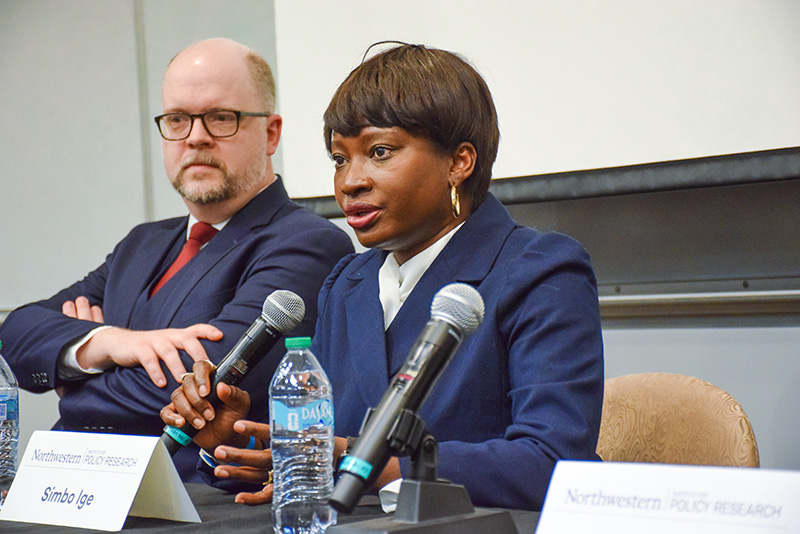
During a Northwestern panel, Olusimbo (Simbo) Ige (r.) and Matthew Smith share insights
from their experiences with public health and policy outreach.
When a researcher publishes a journal article, it is the culmination of years of work.
But the time they may have to persuade a lawmaker to act on that research can be much shorter: two minutes, according to Matthew Smith, chief policy officer with the Illinois Department of Public Health.
Speaking to more than 50 faculty, students, and community members at an IPR panel on March 2, Smith described the challenging, fast-paced environment in which research competes for attention. He was joined by Olusimbo (Simbo) Ige, commissioner of the Chicago Department of Public Health, IPR psychobiologist Emma Adam, and the panel’s moderator, IPR biological anthropologist Thomas McDade.
A Crisis of Trust in Public Health
The panelists agreed: It’s a challenging time to deliver health messages to the public, who have grown increasingly skeptical of institutions.
Smith pointed to dwindling trust in the Centers for Disease Control and Prevention. Confidence declined during the COVID-19 pandemic and has plummeted over the last year as federal policy changes have crippled public health infrastructure.
“Public health has gone beyond, ‘I’m a doctor, and so I told you what to do,’ and then you say, ‘Yes, ma’am,’” Ige said. “That doesn’t work.”
Mis- and disinformation during the pandemic—particularly around vaccines—revealed how fragile that trust had become.
“What will make someone go to their neighbor or friend or someone with no science degree at all?” Ige asked. “The trust is so shattered that people are just grasping for anybody they can relate to.”
“People felt like the systems did not serve them and the system did not listen to them,” she added.
However, ruptures can create openings for new possibilities.
“Sometimes when something is broken, you have the opportunity to rebuild it better, stronger,” McDade said.
Smith agreed that the goal should not be a return to the pre-pandemic status quo.
“If you have a beach house and a hurricane comes through and your house falls into the ocean, you don’t rebuild on the sand dune it was on,” he said. “For better or for worse, we are now in a situation where we need to change.”
Stories That Move the Needle
In today’s information environment, panelists said compelling narratives can help research cut through the noise.
“I like to make data into real, palpable, relatable stories,” Ige said.
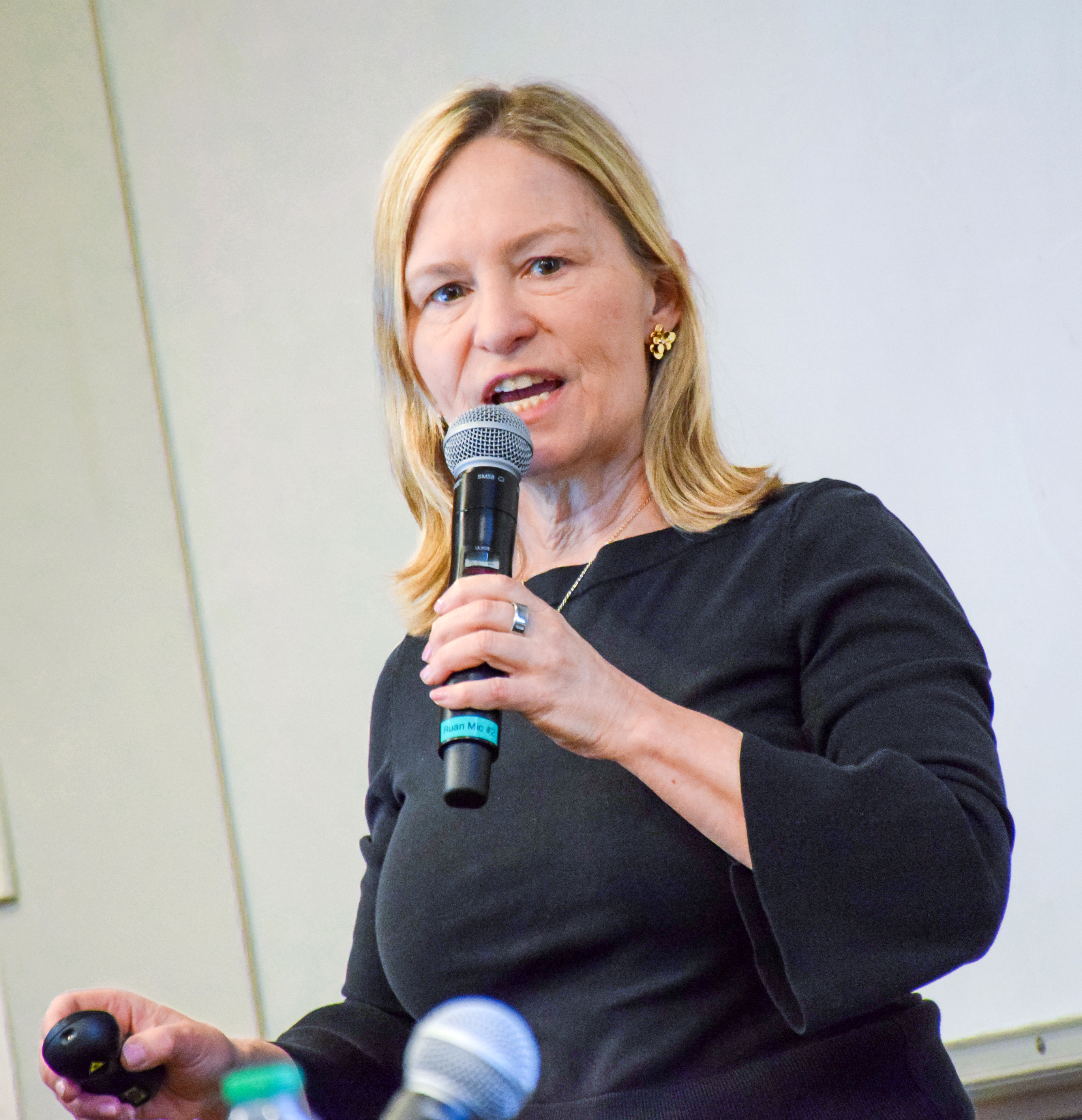
Panelist Emma Adam shares examples from her work.
She described a COVID vaccination campaign she helped lead while serving as assistant commissioner in the New York City Department of Health. To increase vaccination rates in public housing, the department recruited residents who had already been vaccinated to serve as messengers.
“They wore t-shirts saying, ‘I got vaccinated. Ask me about it,’” Ige said.
These community members shared their own experiences—perhaps noting they had a fever after the shot but recovered quickly. The approach proved highly effective: Vaccination rates among public housing residents rose from 39% to 98%, exceeding the city average.
Experiences like this have convinced Ige that experts must “connect more often with practitioners, policymakers, the general public—and not just live in our bubble.”
“Policy research needs to be less afraid of engaging in this change process,” Smith said. The traditional approach—“Here’s my paper,” he said, mimicking sliding a document across a table—no longer suffices.
“I think we need to be thinking more globally about how we approach research and change as part and parcel of the same thing,” Smith said.
Adam agreed that most academics probably are “not doing enough” when it comes to policy outreach. To reach a broader audience, her team has applied for grant funding to develop social media content that counters misinformation portraying cortisol, a stress hormone, as universally harmful.
Public understanding is critical, in part because it shapes what policymakers can accomplish, Ige noted.
“What I do is superseded by what the city council does,” she said. “And what the city council does is influenced by what their constituents want—which means the real power brokers here are the community members.”
The kinds of narratives matter as well.
“Let’s tell more positive, inspiring stories of what works,” Ige urged.
Smith added that experts have a responsibility to present the full picture of public health evidence—what he calls “completing the sentence.” For example, graphs circulating online show that the number of vaccines children receive has increased dramatically since 1983, but they leave out the improvements in health outcomes that followed.
“They don’t tell the whole story,” he said.
Adam offered that academics could help by filling in gaps in understanding with better data or clarify interpretations of policy language with their research.
As a graduate student, Adam was invited to help define the phrase “the best interest of the child” after it was written into a law governing when children could be removed from a home. Drawing on attachment theory, she helped clarify the concept and develop training for frontline workers.
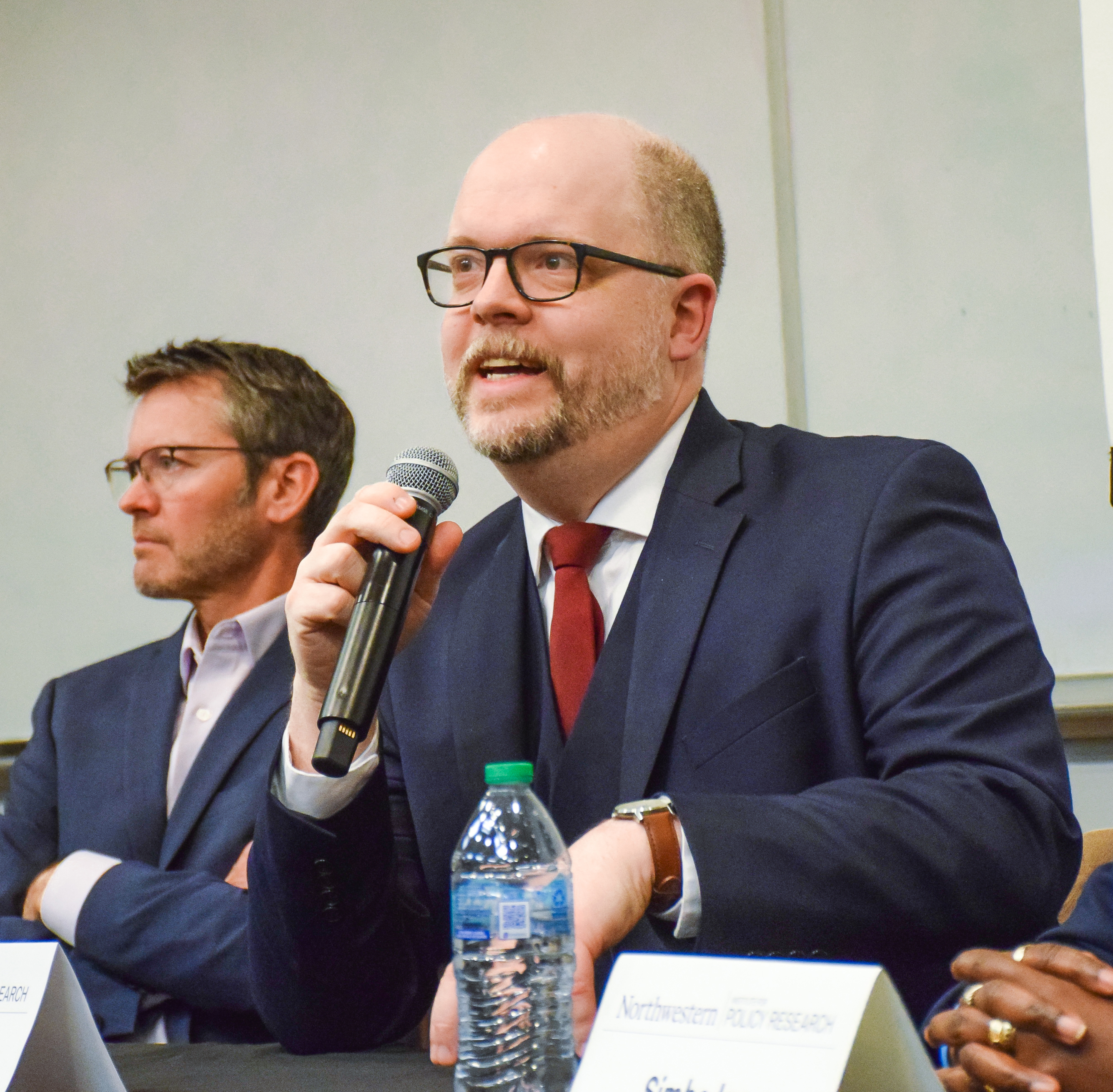
Panelist Matthew Smith (r.), beside Thomas
McDade, urges scholars to weigh in on policy debates.
This is the kind of work, Smith said, that goes beyond merely identifying problems to address how we move from the “the world as it is” to “the world as it could be.”
Research on the Policy Clock
Smith issued a challenge to those present: Go to the state capitol and talk to legislators.
He described the scene in Springfield, Illinois, where lobbyists, citizens, and other advocates often line up “at the rail”—along a staircase leading to the House chamber—to catch legislators on their way in to vote.
After a quick exchange on the issue at hand, the lawmaker will often ask, “‘Do you have data?’” Smith said. “And your answer will be yes, and they will say, ‘Great.’ And then they will go vote.”
If the answer is no, he added, that’s “really embarrassing.”
Researchers don’t need a perfect causal study to weigh in, he added. Their experience and deep knowledge base can still be valuable to policymakers making quick decisions.
“Just go and try it out. See what it’s about,” Smith said.
Emma Adam is the Edwina S. Tarry Professor of Human Development and Social Policy and an IPR fellow. Olusimbo (Simbo) Ige is the commissioner of the Chicago Department of Public Health. Thomas McDade is the Carlos Montezuma Professor of Anthropology and an IPR fellow. Matthew Smith is chief policy officer at the Illinois Department of Public Health.
Photo credits: Lily Schaffer
Published: March 25, 2026.