Sera Young
Professor of Anthropology and Global Health
Morton O. Schapiro IPR Faculty Fellow
PhD in Nutritional Anthropology, Cornell University, 2008
MA in Medical Anthropology, University of Amsterdam, 2002
BA in Anthropology, University of Michigan, 1999
Sera Young has dedicated her career to understanding how women, especially in low-resource settings, cope to preserve their health and that of their families.
After her BA in Cultural Anthropology, she pursued an MA in Medical Anthropology, where she studied maternal anemia in Zanzibar, Tanzania. For her PhD in International Nutrition, she returned to observations about anemia in Zanzibar: that anemic women craved earth, raw starch, and other non-food substances (pica). During her post-doctoral and faculty positions at University of California Berkeley, Davis, and San Francisco, she was involved with a number of studies pertaining to HIV, food insecurity, and infant feeding in sub-Saharan Africa.
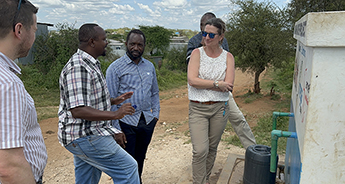
Her current research is focused on quantifying human experiences with problems with water, and unpacking their consequences for nutrition, health, and wellbeing. To that end, she led a large team in the development of the Water InSecurity Experiences (WISE) Scales, the first globally equivalent way of measuring water access and use. The WISE Scales have been used by hundreds of organizations in more than 90 countries.
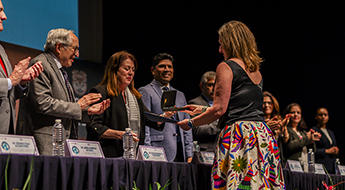
She has co-authored more than 180 peer-reviewed publications and been funded by many national and international agencies. Her most recent accolade is a medal from the Director of Mexico’s National Institute of Public Health, the inaugural “Public Health Champion Award”, which she accepted on behalf of the Water InSecurity Experiences Network of Latin America and the Caribbean for their work on measuring water security. Additional select awards are listed below.
Select Awards and Honors
2025: Public Health Champion, National Institute of Public Health, Mexico
2024: Nevin Scrimshaw Mid-Career Award in Global Nutrition, American Society for Nutrition
2023: Leverhulme Visiting Professor, London School Hygiene and Tropical Medicine
2019: Carnegie Fellowship
2013: Margaret Mead Award, American Anthropological Association and the Society for Applied Anthropology
Appointments
Institute for Policy Research Faculty Fellow; Global Health Studies; Buehler Center for Health Policy and Economics; Buffett Institute for Global Studies; Northwestern International Institute for Nanotechnology; Program in African Studies; Third Coast Center for AIDS; Co-Director of the Center for Water; Co-Editor-in-Chief of PLOS Water; Lead of Water, Nutrition, and Health Equity at United Nations University Institute for Water, Environment, and Health.
Current Research
Household-Level Water Insecurity. Problems with water quality and quantity are increasing in frequency and severity throughout the world. While much is known about how to measure experiences with food insecurity, little is known about how to measure experiences with water insecurity and its ensuing consequences. Young has led the development of the Water InSecurity Experiences (WISE) Scales, cross-culturally equivalent tools to quantify household- and individual-level experiences with water insecurity. The WISE Scales have been implemented around the world by more than 100 governmental, policy, research, and civil organizations.
Food Insecurity. What role does food insecurity play in adverse maternal and child health and nutritional outcomes—especially when mothers and children are living with HIV? What are the types and magnitude of effects—and which of these are modifiable? How can food insecurity be mitigated amongst women and children in low-resource settings? To answer these questions, Young has conducted observational and intervention studies in Tanzania, Kenya, and Uganda.
Pica (Non-Food Cravings) and Health. Is pica—the craving and consumption of non-food items such as earth, charcoal, and ice—an adaptive response to health challenges? What is the relationship between pica and iron deficiency? Using data from East Africa, North America, and elsewhere, researchers have long observed that non-food cravings and iron deficiency are associated, but the nature of the relationship is unclear. Young is using a variety of in vitro and in vivo animal studies, as well as observational studies in human and nonhuman primates, to ascertain the mechanisms underlying this observation, and to test the two major physiological hypotheses about pica: supplementation and detoxification.
Selected Publications
Marphatia, A. A., S. Simiyu, M. F. O’Kane, K. T. Alexander, A. C. A. N. De Castro, (…) S. L. Young, 2025. Gender equality and quality of life must be central to the design and delivery of sanitation. BMJ Global Health, 10(1).
Miller, J. D., C. Staddon, A. Salzberg, J. B. Lucks, W. Bruine de Bruin, and S. L. Young. 2024. Self-reported anticipated harm from drinking water across 141 countries. Nature Communications 15(1): 7320.
K. Connors, L. M. Jaacks, A. Awasthi, K. Becker, R. B. Kerr, (…) S. L. Young, and L. Bliznashka. 2023. Women’s empowerment, production choices, and crop diversity in Burkina Faso, India, Malawi, and Tanzania: A secondary analysis of cross-sectional data. The Lancet Planetary Health 7(7): e558–e569.
Young, S. L., H. J. Bethancourt, E. A. Frongillo, S. Viviani, and C. Cafiero. 2022. Concurrence of water and food insecurities, 25 low- and middle-income countries. Bulletin of the World Health Organization 101(2): 90-101.
Young, S. L., H. J. Bethancourt, Z.R. Ritter, and E. A. Frongillo. 2022. Estimating national, demographic, and socioeconomic disparities in water insecurity experiences in low- and middle-income countries in 2020–21: A cross-sectional, observational study using nationally representative survey data. The Lancet Planetary Health 6(11): e880–e891.
Mao, F., J. D. Miller, S. L. Young, S. Krause, and D. M. Hannah. 2022. Inequality of household water security follows a Development Kuznets curve. Nature Communications 13(1): 4525.
Boateng, G. O., C. L. Workman, J. D. Miller, M. Onono, T. B. Neilands, and S. L. Young. 2022. The syndemic effects of food insecurity, water insecurity, and HIV on depressive symptomatology among Kenyan women. Social Science & Medicine 295: 113043.
Young, S. L., H. J. Bethancourt, Z. R. Ritter, and E. A. Frongillo. 2021. The Individual Water Insecurity Experiences (IWISE) scale: Reliability, equivalence and validity of an individual-level measure of water security. BMJ Global Health 6(10): e006460.
Young, S. L., E. A. Frongillo, Z. Jamaluddine, et al. 2021. Perspective: The importance of water security for ensuring food security, good nutrition, and well-being. Advances in Nutrition 12(4): 1058–1073.
Miller, J. D., C. L. Workman, S.V. Panchang, G. Sneegas, E. A. Adams, S. L. Young, and A. L. Thompson. (2021). Water security and nutrition: Current knowledge and research opportunities. Advances in Nutrition 12(6): 2525–2539.
Young, S. L. 2021. Viewpoint: The measurement of water access and use is key for more effective food and nutrition policy. Food Policy 104: 102138.
Young, S. L., G. O. Boateng, Z. Jamaluddine, et al. 2019. The Household Water InSecurity Experiences (HWISE) Scale: Development and validation of a household water insecurity measure for low-income and middle-income countries. BMJ Global Health 4(5): e001750.
Boateng, G. O., T. B. Neilands, E. A. Frongillo, H. R. Melgar-Quiñonez, and S. L. Young. 2018. Best Practices for Developing and Validating Scales for Health, Social, and Behavioral Research: A Primer. Frontiers in Public Health 6: 149.
Jones, A. D., F. M. Ngure, G. Pelto, and S. L. Young. 2013. What Are We Assessing When We Measure Food Security? A Compendium and Review of Current Metrics. Advances in Nutrition 4(5): 481–505.
Young, S. L. 2010. Pica in pregnancy: New ideas about an old condition. Annual Review of Nutrition 30: 403–22.